

Choosing a school is rarely just about next year. For many families, it’s a decision about the kind of learner — and person — a child becomes over time.
Across West O‘ahu and beyond, more families are exploring independent schools not simply as an alternative, but as a different educational model. The distinction isn’t a single program or feature. It’s the environment created when a school has the flexibility to know students well, design meaningful learning, and build a community around shared values.
Here are several elements families consistently notice when they take a closer look.
When Students Are Known, Learning Changes
Small class sizes are often the first thing parents hear about. What matters more is what those class sizes make possible.
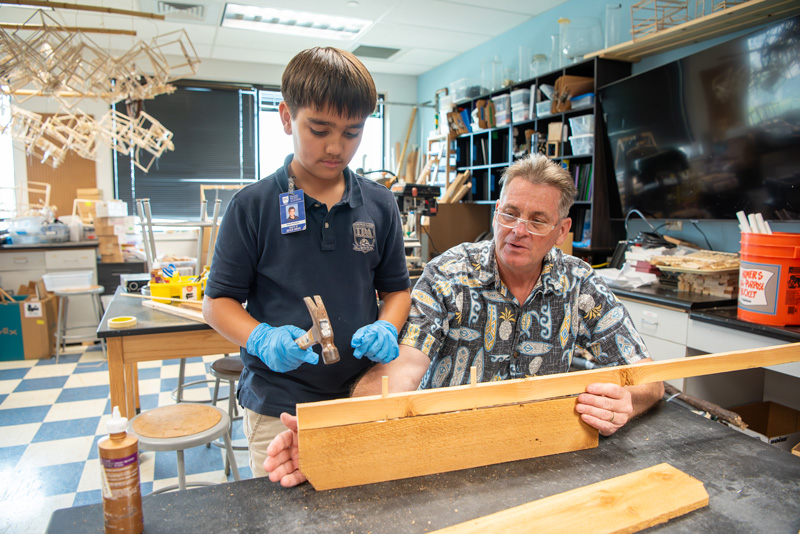
In smaller settings, teachers move beyond delivering content to mentoring students. They can identify strengths earlier, adjust challenges, and support areas where confidence is still developing. When students feel known, they are more willing to ask questions, take academic risks, and stay engaged through difficulty.
Personalization is less about customization and more about proximity — consistent relationships over time.
Academic Rigor Looks Different
Independent schools typically have the autonomy to design curriculum that goes beyond coverage and pacing. This often shows up through approaches such as real-world projects, interdisciplinary work, and discussion-driven classrooms. Students are not only expected to arrive at answers, but to explain thinking, revise work, and navigate ambiguity.
For families, the visible difference is the work itself: presentations, prototypes, research, performances, and long-term projects that mirror how learning happens outside school.
Character Is Part of the Daily Experience
Many schools talk about character. In strong independent environments, character is structural. Students interact across grade levels, participate in service, and operate within communities where expectations are clear and relationships are sustained over years. Skills like empathy, responsibility, collaboration, and leadership develop through repetition — not one-time programs.
Graduates leave not only prepared academically, but practiced in how to work with others and contribute to a community.
A Close-Knit Environment Creates Psychological Safety
Learning requires the ability to make mistakes publicly, revise work, and try again. Smaller school communities often create conditions where students feel comfortable doing exactly that. The continuity of a K–12 setting can deepen this effect: younger students see what growth looks like, while older students step into visible leadership and mentorship roles. For many families, this sense of belonging becomes one of the most significant factors in long-term success.
Opportunity Extends Beyond the Classroom
Independent schools frequently offer broad access to arts, athletics, clubs, and leadership experiences. The advantage is not simply variety, but participation.
Because communities are smaller, students are more likely to try new activities, hold meaningful roles, and explore interests earlier. Over time, these experiences help students discover strengths that may not appear in traditional academic settings alone.
Partnership With Families Matters
A defining feature of the independent model is the relationship between school and home.
Communication tends to be direct and frequent, but the deeper difference is alignment. When educators and families share expectations — around effort, growth, and values — students experience consistency across environments. That consistency is often what allows progress to compound year after year.
Thinking About Value Over Time
Families often ask about return on investment. The answer rarely lives in a single metric. Instead, value appears gradually: a student who becomes confident speaking, who learns how to manage long-term work, who develops strong relationships with teachers, who understands how to navigate challenge.
These outcomes are cumulative. They emerge from an environment designed intentionally over many years.
How Families Evaluate Fit
When visiting schools, a few questions can help clarify whether the model aligns with your child:
Observe the culture: Do students appear comfortable participating and interacting with adults?
Look at student work: Does the work demonstrate thinking, creativity, and revision?
Ask about continuity: How does the school support transitions between divisions?
Listen for relationships: How do teachers describe knowing students?
Fit is less about finding a perfect school and more about finding an environment where your child is likely to be known, challenged, and supported over time.
Independent education is ultimately a long-view decision. For many families, the value lies in the combination of personalization, rigorous learning, strong relationships, and a community that treats growth as a shared responsibility.
Those conditions don’t guarantee outcomes. But they create the kind of environment where meaningful growth is far more likely to happen.