

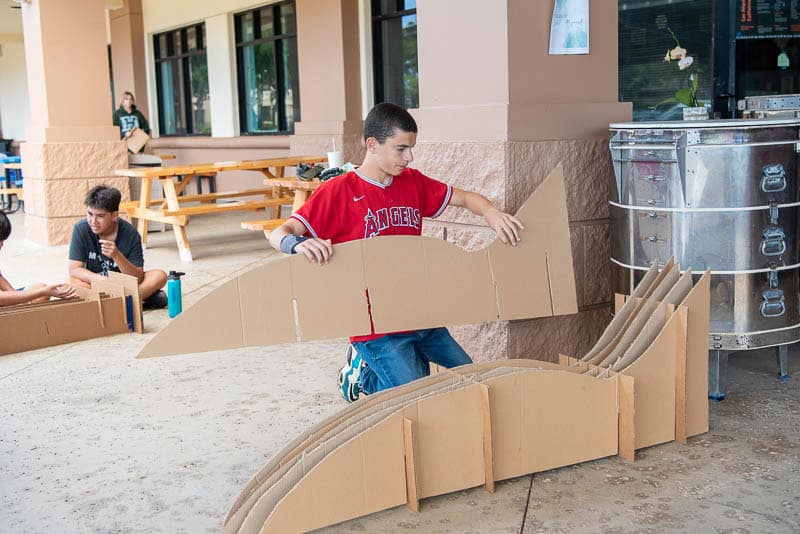
Ask a student what they’re working on, and the answer might sound less like a worksheet and more like a challenge:
How can we design a more sustainable garden?
How do we reduce plastic waste in our community?
What would it take to solve a real problem people actually face?
That shift — from completing assignments to solving problems — is the foundation of Project-Based Learning (PBL).
PBL is often misunderstood as “doing projects.” In reality, the project is the learning. Academic standards, research, writing, math, and critical thinking all live inside the work students are trying to accomplish.
From Memorization to Application
Traditional instruction often separates learning from use: students learn information first, then demonstrate it later on a test.
In a PBL environment, students need knowledge because they are trying to do something with it.
A lesson on the water cycle becomes necessary when students are designing an irrigation system. Data analysis becomes meaningful when students must justify a solution. Writing becomes purposeful when there is a real audience.
When knowledge is used, it sticks. Students remember not just the answer — but why it mattered.
The Skills That Endure
Content evolves. The ability to use it does not.
Project-Based Learning develops what are increasingly described as durable skills:
- Collaboration: navigating roles, perspectives, and shared responsibility
- Critical thinking: revising ideas when first attempts don’t work
- Communication: explaining thinking clearly to others
- Problem-solving: managing ambiguity rather than waiting for instructions
These skills grow naturally because projects rarely unfold perfectly. Students iterate, adjust, and improve — which is where real learning happens.
Motivation Changes When Work Has a “Why”
One of the most noticeable differences families see is student energy. When students have voice in how they approach a problem, they move from compliance to ownership. Questions shift from “Is this graded?” to “Can we try this instead?”
Purpose reduces the need for artificial motivation. Students understand why the learning matters because they are already using it.
Personalization Without Lowering Expectations
Project-Based Learning allows variation in approach while maintaining academic rigor. Two students can work toward the same standards through different paths — different research angles, different solutions, different formats — while still being challenged at a high level.
Personalization is not easier work. It is more meaningful work.
Innovation Requires Permission
Open-ended questions create space for creativity. Students brainstorm, test ideas, build prototypes, receive feedback, and refine their thinking. They learn something important early: first attempts are rarely final answers.
That experience builds confidence — not just in academic ability, but in the belief that they can create, improve, and contribute.
Preparing Students for What Comes Next
The goal of PBL is not simply engagement in the moment. It is preparation for complexity.
Graduates need to know how to:
- approach unfamiliar problems
- work with others
- evaluate information
- communicate ideas
- persist when solutions aren’t obvious
Project-Based Learning creates repeated practice with those realities while academic foundations remain strong. Students are not only learning content. They are learning how to use what they know.
Seeing It in Action
The best way to understand Project-Based Learning is to see the work itself — the questions students ask, the feedback they apply, and the solutions they refine over time.
When learning has a clear purpose, students don’t simply move through school. They learn how to think through complexity, create with intention, and improve their work – habits that extend far beyond any single project.